Renders vs. Reality: An On-Site Quality Audit
This visual chronicle documents the physical execution gaps, material handling errors, and structural misalignments discovered during the final inspection phase. This gallery serves as a practical guide to help first-time homebuyers identify subpar craftsmanship before signing off on project completion.

The Premium Bar Unit
The Breakdown: The foundational framework of this custom feature unit (valued at ₹1.5 Lakhs) suffered from baseline alignment defects from inception. Despite timely stakeholder feedback during the rough-in stage, execution errors were left uncorrected by project supervision.
The Result: The finalized installation exhibits distinct visual asymmetry, including skewed perimeter joints, misaligned edging, and uneven curvature.


Audit Review: Standard professional practice dictates hiding laminate seams and panel joints behind modular junctions or architectural accents. This execution highlights a systemic breakdown in supervisor guidance and basic carpentry precision.

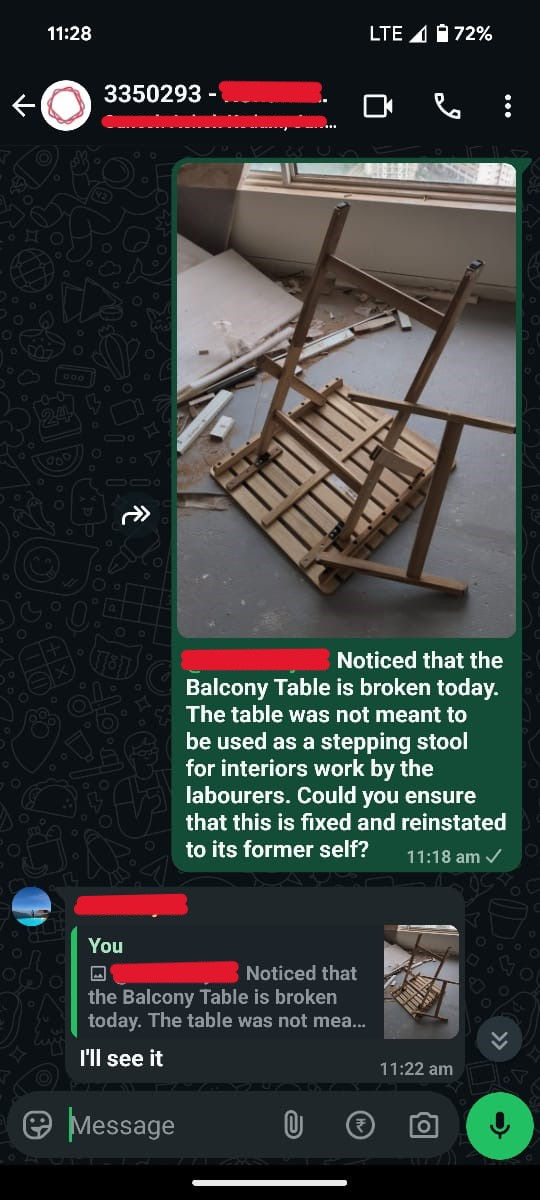
On-Site Material Protection Failure
The Breakdown: Premium outdoor patio furniture, moved onto the site by the homeowner, was subjected to severe negligence. Subcontracted site workers utilized the protected consumer goods as improvised step stools during active electrical rough-ins.
The Result: Structural damage to the furniture set. Despite formal corporate acknowledgments and explicit verbal assurances of immediate financial compensation, remediation remains completely un-processed.


The Breakdown: An unprecedented electrical routing decision resulted in a heavy-duty three-pin utility socket being installed directly onto the open ceiling plane. Furthermore, the specialized wiring designated for a primary hanging lamp was buried inside the false ceiling without ever being looped or connected to a functional electrical control board.
The Structural Result: The homeowner is left with a completely non-functional, "dead" set of wires hidden behind the drywall. Because the execution team sealed the layout prematurely, this critical defect cannot be corrected or re-routed now without completely tearing down and breaking the finished false ceiling.
Audit Review: This layout fundamentally violates basic residential electrical ergonomics and safety codes. Concealing unlooped, active or dead wiring inside a sealed ceiling cavity without a strategic access panel represents a severe flaw in quality assurance and on-site supervision.
The Guide’s Advice: Never let a contractor close up a false ceiling or a dry-walled area until you have physically verified that every wire is actively looped to its corresponding switchboard and tested for continuity. Once the ceiling is painted and sealed, fixing an internal wiring oversight becomes a destructive, expensive renovation of its own.
Anomalous Electrical Engineering
%20-%20redacted.png)
Non-Transparent Billing & Field Accountability
The Breakdown: This section highlights critical communication breakdowns where on-ground leads attempted to introduce un-itemized, third-party material fees outside the official payment gateway.
Audit Review: Internal audit logs capture project leads explicitly requesting the removal of payment receipts and transaction records from official communication channels to prevent central corporate compliance mechanisms from flagging the irregularity.

The Guide’s Advice: Never delete a digital trail. Maintain absolute records of every WhatsApp message, official email, and transaction receipt to protect your consumer rights when facing milestone coercion.
_edited.jpg)